TL;DR:
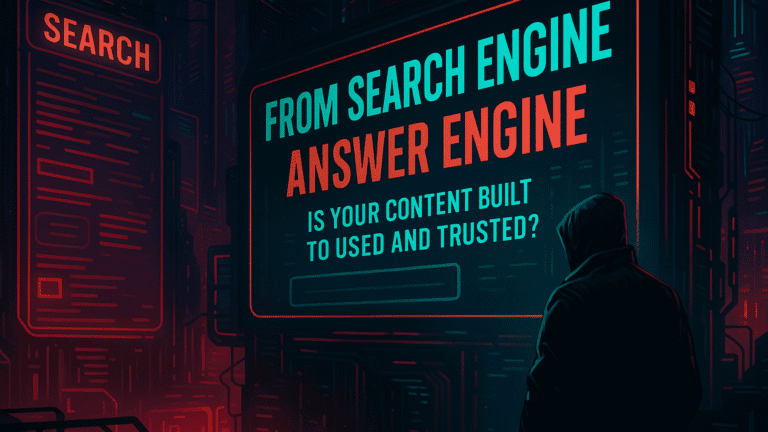
TL;DR: Traditional search is being replaced by AI that generates direct answers instead of providing link lists. Businesses must now optimize for being included in AI responses rather than ranking in search results, requiring consistent presence across trusted sources and machine-readable content.
Key Strategies for LLM SEO Success:
- Focus on being cited and remembered by AI systems rather than ranking high in search results
- Ensure factual consistency and third-party corroboration across multiple credible websites
- Structure content with clear author attribution and data that AI systems can easily parse
- Build presence across domains rather than optimizing just your own website for crawlers
- Create content that AI trusts enough to reference when generating answers
- Optimize for being included in the single synthesized reply rather than competing for clicks
- Shift from traffic-focused SEO to presence-focused AI optimization strategies
Intro:
For two decades, digital visibility meant mastering Google’s rulebook. You optimized your keywords. You chased snippets. You built backlinks and hoped the algorithm liked what it saw.
But that system is collapsing in real time.
The traditional search engine—blue links and all—is being outpaced by a new model: AI that doesn’t search the web so much as “respond” to it. Tools like ChatGPT, Gemini, and Microsoft Copilot are replacing the hunt for links with direct answers, generated in real time. They summarize. They converse. They cut the web down to a single, synthesized reply.
This shift isn’t subtle—it’s structural. As MIT Technology Review put it, we’re watching the end of search as we’ve known it. https://www.technologyreview.com/2025/01/06/1108679/ai-generative-search-internet-breakthroughs/)

AI agents aren’t just surfacing information—they “are” the interface. Ask about the best hiking boots under $200, and the AI doesn’t point you to ten reviews. It digests them, decides what matters, and gives you a name. That name may come with a citation. It might not. But if your product—or your content—isn’t part of that answer, you’re not just lower in the rankings. You’re gone from the conversation.
This is what experts like Gavin Heaton call the new visibility crisis. As (he writes on LinkedIn and you can find him at https://www.linkedin.com/pulse/new-rules-visibility-how-show-up-ai-search-gavin-heaton-g4o3e), traditional SEO tactics are losing traction, and visibility now depends on whether you’re remembered and cited by the LLMs shaping these answers.
The result? A closed loop. These models begin with what they already know, such as data scraped, trained, and embedded months ago. In some cases, they’ll reach out to the web using live tools like Retrieval-Augmented Generation. But that only helps if your information is “credible” and “structured” enough to be pulled in. AI won’t link to you just because you rank. It references what it trusts.
And the standards for trust are shifting, fast.
According to Seer Interactive (https://info.seerinteractive.com/the-factors-that-influence-ai-search-visibility), being cited by AI depends on multiple signals: factual consistency, third-party corroboration, and clear author attribution across the broader web—not just on your own site. Brands once optimized for Google’s crawl bots. Now they’re trying to impress a machine that doesn’t crawl—it composes.
Meanwhile, Writesonic’s research( see https://writesonic.com/blog/how-to-get-cited-by-ai) shows that AI-generated answers rely heavily on content that appears consistent across domains, is linked to recognized sources, and contains structured data that’s easy to parse. The message is clear: influence is no longer just about getting seen—it’s about being “included.”
This isn’t just a shift in strategy. It’s a shift in power.
Instead of directing people toward information, AI intermediates it, so we find that the answer box is now the destination. And that means every business — from B2B consultancies to consumer brands — needs to rethink how they show up. Because in this model, there’s no second page. There’s barely even a first.
“This is the dawn of AI-first visibility,” says Advanced Web Ranking (https://www.advancedwebranking.com/ai-brand-visibility). They go on to say “Forget traffic. Think presence.”
For marketers, communicators, and operators, the implications are hard to ignore. Your job isn’t just to optimize content for human readers, rather it’s to make sure AI sees it, understands it, and remembers it — accurately and favorably.
The old search economy was about playing the algorithm. The new one? It’s about becoming part of the answer.
“We spent decades learning to game the algorithm. Now we need to become part of the answer itself — because when AI responds, there’s no second page to fall back on.”
— Wayne Clayton, The AI Answer Man
Call to Action
Want help training your team or building smart ChatGPT workflows?
👉 Book a Free AI Readiness Call with Importynt AI
We’ll show you how to turn ChatGPT into your team’s secret weapon.